While we welcome discussion on this blog, issues meant for feedback from the Network should be posted on the discussion board by emailing caphealth@yahoogroups.com
Tuesday, July 5, 2011
Cleft Palate success story
Friday, July 1, 2011
A trip toward the DR
In Ferrier: Beraaca Clinic
They have school, ophanage, church, and clinic all together!
They are making a bigger pharmacy.
The diseases seemed to be a pretty standard mix with some variations. They mentioned vaginal infection and typhoid were particularly bad. But very little cholera!
Malfety (by ft liberte) 7-1 visit
This is a growing clinic: Father Tiyou built a large, brand new clinic that will begin being used soon.
An interesting approach to malnutrition: they show relatives how to mix an enriched milk paste.
Wednesday, June 29, 2011
Visit to Robillard
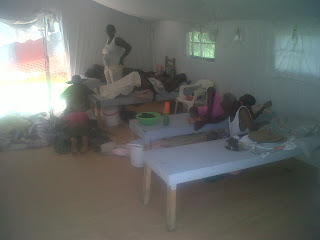
They have 29 people with cholera last week, right now there are 14 left.
Yesterday MSF came and gave 140 ivs but that's not enough because they keep receiving ppl. 10 cases could use 140 ivs so they need more. We gave some and need to be vigilant about supplying more. The nurse taking care of all patients says she needs help.
She isn't getting get paid for anything (she is voluntary) since October. Don't want to think about how the cholera situation in the community would be without her...
Julian Malinak, MPH
3792-0060
3441-1546
Team Leader, Cap Haitien Health Network
Facilitating coordination among health organizations in northern Haiti
caphealthnetwork.org
Sent from my mobile device--pardon the brevity
Wednesday, June 22, 2011
Sacred Heart Center
Here's how they keep track of the kids:

Helping Babies Breathe
About 1 in 10 babies born without breathing. When you have the mother comes in your clinic you should prepare the area for the delivery, making sure that the area is clean. Helping the mother wash her hands and chest for skin to skin care.
The room must be warm has to be well lit to assess the baby. You have to check the equipment once the baby is born, dry the baby because drying helps keep the baby warm and stimulates breathing.
If there is meconium you need to clear the airway before drying. When you hear a cry it means the baby is breathing. If the baby does not cry it means the baby is not breathing at birth.
Check to see if the baby is breathing by listening to the sounds and watching the movement of the chest. Wait about 1 minute up to 3 to cut the cord, encourage the mother to breastfeed.
When a baby is born but not breathing you ventilate with a bag and mask. Ventilation opens the lungs with air. You need to control the position of the baby's head and look for movement of the chest. The mask should cover the chin, mouth, and nose not eyes. If the baby does not begin to breathe after 1 minute of ventilation with chest movement then you check the baby's heart rate. You can check the baby's heart rate by feeling the umbilical cord pulse because its attaches to the baby's abdomen. You have 3 minutes to make the baby breath if it have been more then 3 minutes you should call a doctor to take the baby to a hospital.
When the class was finish everybody received their own kit that had a baby, ventilate bag and mask to take back to their clinics to teach other people how to help babies breathe.
Sent from my BlackBerry® smartphone powered by Voilà
Saturday, June 18, 2011
CTI Water Testing

The past two weeks, Gaby Vincent of Sonje Ayiti has been hosting a team who have been doing water testing in the region. Compatible Technologies International design food and water technologies appropriate to low-income countries as a sustainable method of improving the quality of lives. They have previously worked with Meds and Food for Kids to provide their small scale factory equipment, and with Sonje Ayiti with their cocoa grinding equipment. Their latest project has been to design an innovative water purification system, which engineer students of St Thomas’ University in Minnesota designed, and with their professor, came out to Cap Haitien to test. The Water ‘Aqualyser’ uses electrolysed metal plates to convert salt into chlorine, which kills bacteria and harmful pathogens commonly present in untreated drinking water. Their prototype includes a foot pedal to create enough energy to generate the electricity.
The aims of their trip to Cap Haitien were to test out their prototype, and to think about ways they can improve it to make it more appropriate to the local environment and culture. One step of this process was to gain water samples from across the region to find out how prevalent e-coli is, and test the prototype on some of the most contaminated areas.
The network assisted them by enabling all the in-country water NGOs to collaborate. During a meeting held on CTI’s first day, they were able to discuss their prototype and get essential feedback on what design would be sensitive to the region. For example, if it were able to be attached to the end of a hand pump it would be accessible to almost any community, a huge leap from any other purification or filtration system used in Haiti today. They were also given a list of sites that are likely to contain e-coli, such as Limonade and Shada, which they used to plan their water testing.
Susan and Doug Rakoczy of Life Water Canada, Life Water OMS and Global Hope also donated an incubator to the team to help with their water testing, and CTI gave the couple support on how to use the incubator as they are new to water testing.
For the network, CTIs work will give us vital information to prioritise needs of water systems in the north of Haiti. Where a presence of e-coli is shown in untreated drinking water, NGOs such as SIFAT, World Water Missions and Fountains of Hope, who already have purification systems, can be directed to help.
The network took the CTI team to Notre Dame des Lourdes Clinic and School in Cap Haitien, where, if there is a presence of e-coli found in their water, SIFAT will install a water purification system. We also took them to Shada where they tested four shallow wells, with the guidance of Madame Bwa the community leader, and Ashley Dahlberg from SOIL.
Donation of Supplies from Dilaire Clinic to the Network
Thankfull
y, Haiti Hospital Appeal happened to have a group of five volunteers in Haiti this week, who we enlisted to help with this tedious task. A job
that could have easily taken a week to complete only took a day with thanks to them.
Now with everything listed on our inventory and the boxes labelled and organised, we are ready to start the distribution to our network members.


Go to ‘distribution and inventory’ section and click on the tab ‘Dilaire Clinic, June 2011’ on the spreadsheet to see the full list of donated materials and please contact us if you are interested in obtaining any of these supplies.

Friday, June 17, 2011
We started with the Bendawest Clinic. Here's the exam room:
Here is Fresnel (a volunteer at the hospital who speaks English--good for me considering my Creole is still quite awful) with Supplementary Plumpy, part of the Plumpy'nut Family of RUTFs (ready-to-use therapeutic foods), one of big areas of interest. Here they give treat patients with three months of Plumpy'Nut, supply the mother with a month's supply at a time.
MFK Haiti is a big RUTF producer based in Cap (they employ locals and source from Haitian peanuts) that produces its own brand of RUTF but is becoming part of the Plumpy'Nut network. As much as I like health, I think that the biggest causes of poor health down here aren't related to poor health care but to a lack of livelihood and poverty, so I love the model of MFK.
Here's the storage place at the clinic. Note the covering to protect from rats and other creatures. Essential for storage here.
Thursday, June 16, 2011
Getting used to things...
--The volunteer village of Haiti Hospital! Awesome visit to a peaceful, secure compound with renovated buildings.
Been trying to learn Creole, which has been going quite slow--I need to try to immerse myself more! I have, however, been trying to hone my sense of the aid world here with "Haiti in the Balance, Why Foreign Aid Has Failed and What We Can Do About It." Good stuff--it's always helpful be reminded that what feels like good work or policies may have unintended, negative consequences.
Sunday, June 5, 2011
After one week...
--Distributing supplies (soap, band-aids, hand sanitizer, ORS, etc.) down at Shada with Hannah and getting a tour of the area. Very cool to see the work SOIL has done down there with the public toilet, clinic, and road construction.
--Several trips to Hopital Sacre Coeur. Right after I arrived at the airport on Saturday, we went to meet Peter Kelly, President of the CRUDEM Foundation, which manages the hospital. An incredibly impressive hospital, not only for its modern equipment but mainly because it has a great balance of Haitians and foreigners working together. It is managed and staffed by Haitians, while foreigners continues to be involved in infrastructure development, technical assistance, and mentoring and training of staff.
--We have ample amounts of Sodium Chloride that we have been distributing to Hopital Sacre Coeur, To Haiti with Love, and other organizations and clinics in the area! It's been fascinating to start to see the health-related supply chains at work in the area, and I'm still trying to get my head around the multiple organizations involved in procurement and distribution here.
--A trip to Haiti Hospital Appeal with Hannah, where she showed me the rehabilitation ward that she continues to work.
--We are trying to coordinate surgery for a child with tetralogy of fallot, a fatal congenital heart condition, seen by Hands up for Haiti in May and hospitalized in Hopital Sacre Coeur. A flight to Port-au-Prince, where a group of surgeons from the US are currently holding a clinic, has been arranged and we are optimistic that we can locate the child! People have really come together on coordinating about this.
--Visited the brand new emergency department, made possible by Israel, at Justinien Hospital. Avi Hirsch, a doctor from near Tel Aviv with a wealth of experience in emergency medicine around the world, gave us a tour. The facility looks great, and it will be interesting to see how it develops over the next months. I look forward to continued communication with Dr. Hirsch!
Thanks to everyone for welcoming me to this beautiful land and teaching me about your work here. It's great to be here.